1 Million Hwaseong Special 'World Filial Piety Expo' in Hwaseong, the Hometown of Filial Piety
Last year, I wrote a column in News S titled 'Professor Lee Hong-gu: Key Figure in First Reenactment of King Jeongjo's Royal Procession.' After reading it, Professor Lee Hong-gu, who is ninety-one years old, thanked me and bought me lunch. The professor was my homeroom teacher at Suwon North Middle School and my Korean language teacher at Suseong High School. At that meeting, he expressed sorrow over the frequent suicides of teachers these days and spoke about the importance of character education.
The Character Education Promotion Act defines 'character education' as 'education aimed at cultivating human qualities and competencies necessary to live together with oneself, others, community, and nature by properly and soundly cultivating one's inner self.'
The 'Eight Core Values of Character Education' are filial piety, courtesy, honesty, responsibility, consideration, respect, communication, and cooperation.
Park Yong-geum, a Wonkwang University humanities and social science research professor and director of the Institute for the Study of Mind, stated, 'Filial piety does not end with serving parents but becomes the foundation of self-cultivation (修身), and it is important to bring joy to parents' hearts and uphold their will (養志).'
It is true that filial piety is the foundation of self-cultivation.
The relationship between parents and children is connected through love and respect. Parents pour their love onto their children, who are their extensions. Children show respect to their parents, who are their source. This is filial piety. There is a saying that filial piety is the foundation of all conduct. Filial piety was also at the center of our nation's traditional way of life, cultivation, and governance.
However, during the rapid process of industrialization and modernization, while life became more affluent, filial piety—our nation's traditional spiritual culture—has been neglected. Economic support for elderly parents is cut off, they are abandoned, and sometimes even killed.
Various cases of elder abuse have become regular fare in the media. This is not unique to Korea. Elder abuse has long been a serious social problem, to the extent that the UN designated June 15 as 'World Elder Abuse Awareness Day.'
Professor Lee Hong-gu emphasized that character education on filial piety is most important in this social climate. He then handed me a copy of the 'Plan to Lead Filial Piety Culture' that he had organized.
Following a declaration stating 'Filial piety is love, happiness, and the root of the soul. Filial conduct is the starting point of all actions and the fundamental principle of ethics and morality. Parents are the greatest teachers, and the home is the primary school,' the plan includes content about establishing ordinances to encourage and support filial piety culture.
The plan also contains detailed operational guidelines and activities, including the establishment and operation of a Filial Piety Character Education Academy.
I agreed with the proposal to establish the Korea World Filial Piety Foundation and host the 'World Filial Piety Expo,' International Symposium on Filial Piety Culture, and Filial Piety Festival.
I wish Hwaseong City would undertake such an initiative.
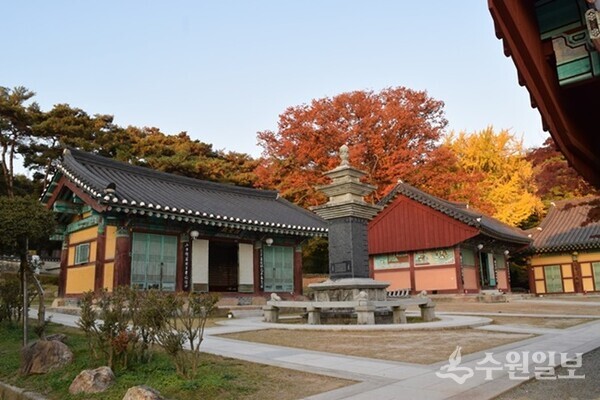
Hwaseong is home to King Jeongjo, who embodied 'transcendent filial piety (出天之孝),' and his father Crown Prince Sado (later posthumously honored as King Jangjo), and Yongjusa Temple, which is imbued with King Jeongjo's filial devotion.
Yongjusa Temple was built as the main temple for the Yeongneung Royal Tomb, where Crown Prince Sado is buried. It was built on the site of Galyangsa Temple, which was founded during the reign of King Munseong of Silla. During King Jeongjo's reign, the renowned Buddhist monk Bogyeong was appointed as the Chief Dharma Master for all eight provinces (八道都化主), and Yongjusa Temple was constructed with 87,000 nyang donated by central government officials and provincial governors.
King Jeongjo personally composed the 'Yongjusa Temple Prayer of Buddhist Reverence and Blessing' (龍珠寺 奉佛祈福偈), commissioned Prime Minister Chae Je-gong to write the upper beam inscription (상량문) for the Daeungbohjeon Hall, and had Yi Deok-mu, a Gyujanggak inspection official, write the temple's couplets. The Daeungbohjeon's rear Buddhist painting is a work by Danwon Kim Hong-do, regarded as the greatest painter of the era.
Yongjusa Temple is called the main temple of filial piety because King Jeongjo issued the Sutra of Filial Piety here. It is said that woodblocks were created to print copies, which were then distributed to the people every winter solstice.
The Sutra of Filial Piety woodblocks are still preserved at Yongjusa Temple and have been designated as National Treasure No. 1754. Copper and stone plates donated by King Sunjo remain well-preserved.
The Parental Gratitude Monument at Yongjusa Temple also attests to the temple's commitment to filial piety.
The Hoseong Hall (護聖殿) is another structure that confirms Yongjusa as a temple of filial devotion. Hoseong Hall enshrines the spirit tablets of Crown Prince Sado (posthumously honored as King Jangjo), Queen Heongyeong (Hyegyeong Palace), King Jeongjo, and Queen Hyoui.
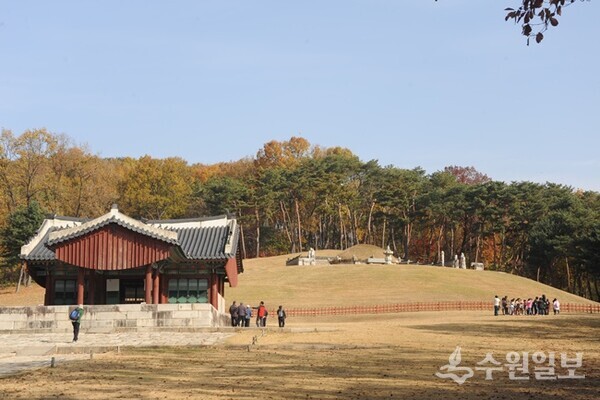
Are there any cultural heritage sites as emblematic of filial piety as Yongjusa Temple and the Yeongneung and Geongneung Royal Tombs, which embody King Jeongjo's filial devotion? Moreover, near Yongjusa Temple, there are remains related to Choi Roo-baek, a filial son from the Goryeo period who killed a tiger to avenge his father's death.
Nearby Suwon City has the UNESCO World Heritage Suwon Hwaseong Fortress and Hwaseong Haenggung Palace, created under King Jeongjo's direction, and King Jeongjo's royal procession is held every autumn.
As the 'hometown of filial piety,' Hwaseong possesses an exceptionally suitable historical and geographical environment to host filial piety expos or festivals, and to establish filial piety museums and experiential facilities.
Furthermore, having surpassed a population of 1 million last year, the city is on the threshold of becoming a special metropolitan city.
I hope the city will carefully consider undertaking filial piety-related projects.