Special Series Two-Year Journey of Pyeongtaek-Dangjin Port Development Council Shined in Harbor Development Contribution and Role
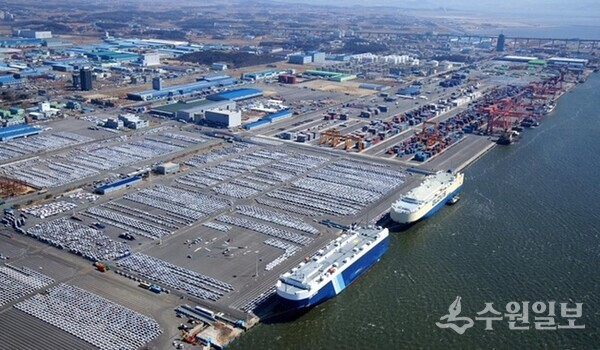
[News S = Reporter Park Chan-hyuk] Although Pyeongtaek-Dangjin Port is a young port that has been open for less than 40 years, it is blessed with geographical location and natural conditions unaffected by natural disasters.
Thanks to this, it continues to show remarkable growth, including total cargo throughput of 117 million tons (as of end of 2023) and 11 consecutive years as the nation's number one in automobile cargo handling.
However, annual tax revenues reaching trillions of won go to the central government as national taxes, while local governments face negative externalities such as environmental pollution, road damage, traffic accidents, and traffic congestion.
This is why there is a limit to upgrading the port's development to the next level.
(Association) Pyeongtaek-Dangjin Port Development Council judged the phenomenon to stem from insufficient interest from local politicians and citizens, and has been receiving good evaluations for operating Pyeongtaek Port Promotion Academy for two years with support from Pyeongtaek city.
As the council concludes its two-year harbor academy, it introduces the causes of Pyeongtaek-Dangjin Port's rapid growth, the effects of the harbor academy, and the future role of port civic organizations in three parts: upper, middle, and lower. (Editor's note)
(Part 1) Civic Organization (Association) Pyeongtaek-Dangjin Port Development Council is Born
◇Pyeongtaek-Dangjin Port's Automobile Cargo Handling Ranks National Number One for 11 Consecutive Years in Rapid Growth
Pyeongtaek-Dangjin Port is located in the center of Northeast Asia, including China, Russia, Korea, and Japan, and has infinite potential to develop as a comprehensive trading port.
Located in Asan Bay, it is blessed with excellent geographical conditions unaffected by typhoons and tidal waves, and has secured adequate channel depths allowing constant entry and exit of 50,000-ton class vessels.
Moreover, it is positioned at the maritime gateway to Korea's capital region and central regions, and forms an extensive transportation network through the West Coast Expressway and National Routes 38 and 77.
The West Coast Expressway (Incheon-Mokpo) and National Route 77 (Paju-Yeosul, Jeollanam-do) connect the north-south axis of the nation, while the Pyeongtaek-Jecheon Expressway and National Route 38 (Asan-Pyeongtaek-Anseong) connect the east-west axis, enabling access to Incheon Airport within approximately one hour and Busan within approximately 4-5 hours.
In addition, it has a transportation network reaching all directions, connected by various national routes and local roads including National Route 39 (Uijeongbu-Buyeo, Chungcheongnam-do), National Route 43 (Pyeongtaek Oseong-Sejong), and National Route 45 (Seosan, Chungcheongnam-do-Pyeongtaek-Gapyeong).
Under these geographical and geopolitical conditions, the government established development plans for Pyeongtaek-Dangjin Port through designation and master plans for the Asan Industrial Complex development zone in the 1980s, and the port was planned as an alternative port supplying 17 berths including some cargo berths from Incheon Port, such as grain, steel, and timber.
After the first LNG-dedicated vessel entered on October 31, 1986, the port was designated and announced as a trade port under the Port Act on December 5, 1986.
Spanning Asan Bay from Poseung-eup, Pyeongtaek to Songsan-myeon, Dangjin, the harbor has a water surface area of 110 square kilometers and depths of 11-18 meters, with East Pier, West Pier, Songak Pier, Godae Pier, Passenger Pier, Sand Pier, and Dolphin Pier.
Selected as one of three major national strategic ports and five major national development projects, it has achieved continuous growth and has formed industrial belt zones with LNG receiving terminals, LPG distribution centers, thermal power plants, industrial complexes, and comprehensive logistics complexes.
Total cargo throughput stands at 117 million tons (as of end of 2023), and with 11 consecutive years as the nation's number one in automobile cargo handling, the port continues to show remarkable growth in just under 40 years since opening, much later than other major domestic ports.
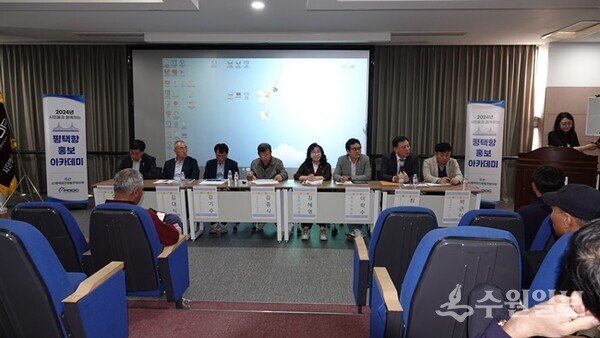
△ In Reality, First Civic Organization Born, Led by Professors, Media Figures, Port Union Members, and Business Owners
This rapid growth has benefited the national economy; however, it has brought negative externalities to Pyeongtaek and Gyeonggi Province, where the port is located, damaging their interests and competitiveness.
Annual tax revenues of trillions of won from cargo throughput all go to the central government as national taxes, while local governments of Gyeonggi Province and Pyeongtaek have suffered from environmental pollution from vessels entering and leaving, air pollution and traffic congestion from cargo trucks, traffic accidents, and road damage as Pyeongtaek-Dangjin Port has become more active.
Additionally, as former Ministry of Oceans and Fisheries bureaucrats (a term combining "happiness" and "mafia") monopolized positions in affiliated agencies under the ministry, Pyeongtaek, which showed little interest in ports, became completely excluded from port development and advancement.
In this process, in 2018, Professor Lee Dong-hyun of the Department of Trade at Pyeongtaek University (current President of Pyeongtaek University), Choi Sung-il, CEO of Changun International, Kim Jong-sik, former Deputy Director at Yonhapnews Pyeongtaek Bureau (current CEO of Human Media Journal), Kim Ki-soo, CEO of Pyeongtaek Citizens News, Kang Hae-moo, CEO of Gyeonggi Auto Car, and Kim Dae-sik, Chairman of Pyeongtaek Port Transport Workers Union, served as founding members and obtained authorization from the Ministry of Oceans and Fisheries for the incorporated association 'Pyeongtaek-Dangjin Port Forum,' marking the first civic organization actually born related to Pyeongtaek-Dangjin Port.
In 2022, the legal entity name was changed from 'Pyeongtaek-Dangjin Port Forum' to 'Pyeongtaek-Dangjin Port Development Council,' and it is making significant efforts toward local society including local governments, private sector, civic organizations, and citizens to break away from centralized port policy structures.
The Pyeongtaek-Dangjin Port Development Council is interested in local port governance.
To achieve this, it determined that essential approaches to △institutional foundations and △establishing a social and cultural atmosphere are urgent, and has been operating a harbor academy for the second consecutive year targeting Pyeongtaek citizens who are unfamiliar with the trade port even though it is located in Pyeongtaek, showing good results.
Plans are underway to expand to residents of Gyeonggi Province.
This is because local port governance can only be achieved when indifference transforms into interest.
Additionally, to establish institutional foundations, the council is urging not only talks with the Pyeongtaek Mayor but also the composition of special committees on Pyeongtaek Port in the Pyeongtaek City Council and Gyeonggi Province Council, and has been receiving positive responses.
Through lectures at forums inviting current National Assembly members of the Agriculture, Forestry and Fisheries Committee, the council is publicizing the status of Pyeongtaek-Dangjin Port and also promoting institutional improvements and research centers for Pyeongtaek-Dangjin Port.
So far, the council has held dozens of talks with Pyeongtaek Mayor candidates, National Assembly member candidates, ministerial lectures, as well as seminars and forums for each issue, visits to advanced ports (domestic and overseas) and workshops.
Additionally, in co-hosting with Pyeongtaek University, the council selects and announces the Top 10 News of Pyeongtaek Port and awards related figures who have worked toward port development.
Next Article (Part 2) Operating Harbor Academy for Pyeongtaek Citizens... 'Satisfaction,' 'Sense of Pride'