Exclusive "Jongmyo is a Common Heritage of Humanity...We Will Fight to the End in Solidarity with All Civil Society"
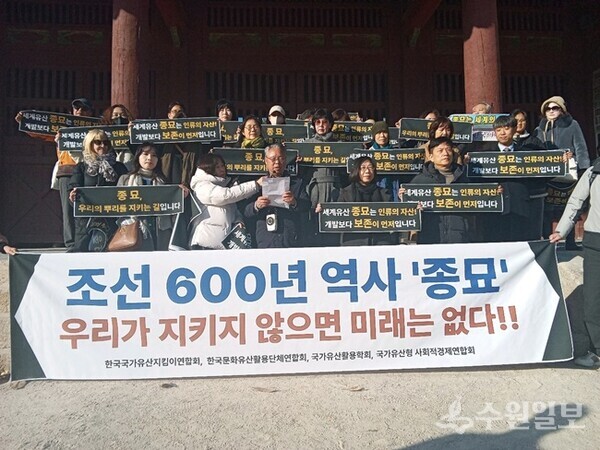
[News S=Reporter Lee Min-jeong] As the Seoul Metropolitan Government allows the construction of super-tall buildings in the Sewoon 4 District in front of Jongmyo, Korea's first UNESCO-designated World Heritage site, a collision between two values—'urban development' and 'cultural heritage preservation'—has sparked what is being called the 'Jongmyo Battle.'
In response, the Korea National Heritage Keepers Association, a representative private national heritage protection organization with approximately 169 keeper groups nationwide and about 70,000 keepers, along with the Korea Cultural Heritage Utilization Organizations Federation, the National Heritage Utilization Society, and the National Heritage Social Economy Alliance, announced a 'Joint Statement to Prevent Damage to the Landscape of UNESCO World Heritage Jongmyo' at 3 p.m. on the 18th at Jongmyo in Seoul.
Through a statement read by Choi Ho-un, chairman of the Korea National Heritage Keepers Association (also president of the Hwasung Research Association), these organizations expressed deep anger and concern at the unilateral administrative action by the Seoul Metropolitan Government in permitting the construction of a super-tall building reaching a maximum height of 142 meters in the Sewoon 4 District near Jongmyo, a UNESCO World Heritage site and sacred ground embodying 600 years of Joseon Dynasty spirit, and at the Supreme Court's ruling that condoned this action.
Raising their voices to say this is "not a simple development decision but a serious incident that has damaged our society's historical conscience and cultural dignity," they directly criticized the decision as a "historical regression" that sacrifices the preservation of cultural heritage—a matter of public interest—for private interests of development profits, hiding behind the weak logic of legal formality rather than legal spirit.
They pointed out the Seoul Metropolitan Government's "extreme irresponsibility and administrative convenience" in abandoning the basic administrative principle of balancing urban development and heritage protection, and expressed disappointment with the Supreme Court's judgment. They criticized the court for ignoring the clear spirit of the law explicitly stated in Article 15 of the 'National Heritage Basic Law'—'not only the national heritage but also the surrounding historical and cultural environment must be protected together'—and the legislative intent of the higher law.
They lamented that by defending Seoul's irregular ordinance amendment, the judiciary essentially abdicated the role of the 'haetae' (a mythical creature symbolizing justice), which judges right and wrong, and issued an indulgence for disorderly development of cultural heritage, stating it will remain "a dangerous precedent shaking the fundamental principles of cultural heritage protection."
The four national heritage-related organizations did not hide their concerns that this could result in UNESCO revoking the World Heritage status of Jongmyo, as happened with Liverpool in England and Dresden in Germany.
In fact, UNESCO transmitted a 'diplomatic and official document' demanding strong measures through the World Heritage Center (WHC) to the National Heritage Agency via Korea's Permanent Representative to UNESCO on the 15th.
Particularly at a time when global interest in Korean traditional culture is rising due to the Korean Wave, they strongly criticized surrendering the dignity of Jongmyo, the symbol of the Joseon Dynasty, to market logic as an act of damaging the Republic of Korea's cultural identity.
They demanded of Seoul, the Supreme Court, the National Assembly, and the government that they ▲immediately halt unilateral redevelopment procedures, ▲reflect on rulings mired in formalistic logic, and ▲immediately supplement shortcomings in the 'National Heritage Basic Law.'
The four organizations declared that they will "recognize this incident as a critical juncture in the Republic of Korea's cultural heritage protection policy and fight to the end in solidarity with all civil society and experts to protect the value of Jongmyo, a common heritage of humanity."
The following is the full text of the statement.
<Joint Statement to Prevent Damage to the Landscape of UNESCO World Heritage Jongmyo>
We cannot hide our deep anger and concern at the unilateral administrative action by the Seoul Metropolitan Government in permitting the construction of a super-tall building reaching a maximum height of 142 meters in the Sewoon 4 District near Jongmyo, a UNESCO World Heritage site and sacred ground embodying 600 years of Joseon Dynasty spirit, and at the Supreme Court's ruling that condoned this action. This is not a simple development decision but a serious incident that has damaged our society's historical conscience and cultural dignity.
Despite the Chinese character for law (法) containing the stern command to realize justice based on fairness (氵) according to natural order (去), this incident represents a historical regression that sacrifices the preservation of cultural heritage—a matter of public interest—for private interests of development profits and hides behind the weak logic of legal formality rather than legal spirit.
The Seoul Metropolitan Government has abandoned its responsibility for cultural heritage preservation. The Seoul Metropolitan Council deleted 'Article 19, Section 5' of the ordinance—a minimum safety mechanism agreed upon with citizens that required review even when development exceeded 100 meters from cultural heritage if the impact was certain. This is an abandonment of the basic administrative principle of balancing urban development and heritage protection, and in serious matters such as development around Jongmyo, it deliberately omits social deliberation and expert consultation processes, using 'ordinance deletion' as a legislative loophole to hide administrative responsibility behind the formal ruling of the judiciary. This represents the extreme heights of irresponsible administrative convenience.
More disappointing is the judgment of the judiciary. The Supreme Court ignored the clear spirit of the law explicitly stated in Article 15 of the 'National Heritage Basic Law'—'not only the national heritage but also the surrounding historical and cultural environment must be protected together'—and the legislative intent of the higher law. By defending Seoul's irregular ordinance amendment, mired in formalistic logic about the lack of explicit regulations in the higher law regarding areas exceeding 100 meters, the judiciary essentially abdicated the role of the 'haetae,' the mythical creature symbolizing justice, and issued an indulgence for disorderly development of cultural heritage. This will remain a dangerous precedent shaking the fundamental principles of cultural heritage protection.
We, the four organizations related to national heritage, hereby declare that preservation and utilization are only possible on the basis of social consensus and the essence of law. Development without procedural legitimacy and essential values is not 'utilization' but 'destruction,' and this represents a serious regression that could result in the revocation of UNESCO World Heritage status as happened with Liverpool in England and Dresden in Germany. At a time when global interest in Korean traditional culture is rising due to the Korean Wave, surrendering the dignity of Jongmyo, the symbol of the Joseon Dynasty, to market logic is an act of damaging the Republic of Korea's cultural identity.
Therefore, we make the following strong demands.
First, the Seoul Metropolitan Government must immediately halt unilateral redevelopment procedures, immediately restore the deleted ordinance, and return to the forum of social deliberation with the National Heritage Agency and civil society.
Second, the Supreme Court must reflect on rulings mired in formalistic logic and recover its own authority based on the constitutional value of national heritage preservation and the 'spirit of the law.'
Third, the National Assembly and the government must immediately supplement shortcomings in the 'National Heritage Basic Law' to establish institutional safety mechanisms that prevent local governments from making irregular ordinance amendments that undermine the intent of the higher law.
We recognize this incident as a critical juncture in the Republic of Korea's cultural heritage protection policy and solemnly declare that we will fight to the end in solidarity with all civil society and experts to protect the value of Jongmyo, a common heritage of humanity.
November 18, 2025
National Heritage Utilization Society, National Heritage Social Economy Alliance, Korea National Heritage Keepers Association, Korea Cultural Heritage Utilization Organizations Federation (in alphabetical order)