Kim Woo-young's Gwanggyo Column Could This Tree Have Been Master Jinggak's Walking Staff?
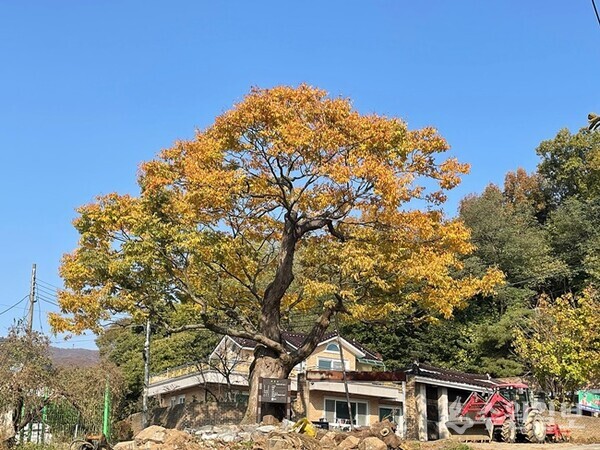
33 Gwanggyo-san-ro 518-gil, Jangan-gu, Suwon (Sanggwanggyo-dong 130, address by parcel number). In the yard of a private residence on Jungganmal Lane in Sanggwanggyo-dong stands a zelkova tree estimated to be approximately 540 years old.
Designated as Protected Tree No. 3 of Suwon in 1982, this tree is a magnificent specimen reaching 12 meters in height and 4.5 meters in circumference. Unlike the zelkova tree alongside the road in Haggwanggyo, which is well-known among Suwon citizens and hikers on Gwanggyo Mountain, few Suwon residents are aware of this tree's existence. This is remarkable given that this tree is some 130 years older than the Haggwanggyo zelkova (410 years old). This is because it stands in a small village set back from the main road and in a relatively secluded area.
This zelkova tree, revered as a village shrine tree by shamans, has an old legend attached to it. Long ago, a Buddhist monk traveling to Changseong Temple on Gwanggyo Mountain rested here and left behind his walking staff. After a considerable time had passed, when the monk returned, sprouts had grown from the staff. Witnessing this, the monk planted the staff in that spot.
According to the tale, the tree grew vigorously and became the village's shrine tree. In fact, if one follows the path along Jungganmal Lane next to this tree and ascends Gwanggyo Mountain, one reaches the site of Changseong Temple. The story gains some credibility given the likelihood that monks used this path to travel to and from Changseong Temple.
However, there is also a legend that the monk in question was Master Jinggak (眞覺國師) Cheon-hee (千熙: 1307–1385) from the late Goryeo period.
Master Jinggak Cheon-hee was a great Buddhist scholar of the Goryeo era who reformed Buddhist policy with a focus on the Hwaeom School. Above the Banghwa Suryujeong Pavilion in Suwon stands the Suwon Changseong Temple Site Monument of Master Jinggak, designated as Treasure No. 14, which records his life and achievements. The inscription was written by Yi Saek, a renowned literary master of the time. However, Changseong Temple fell into ruin, and only its site remains today. This monument, which had been left abandoned at the temple site, was later moved to its present location in Maehyang-dong next to the Banghwa Suryujeong Pavilion in Suwon Hwaseong Fortress.
Master Jinggak traveled to the Yuan Dynasty at age 57 and studied Seon Buddhism for two years before returning to Goryeo to become a National Preceptor (國師). The title "National Preceptor" means "Teacher of the Nation," a position that only highly respected monks of profound practice and virtue could hold. Master Jinggak entered nirvana at Changseong Temple on Gwanggyo Mountain.
Changseong Temple was a Hwaeom School temple during the Goryeo period, but its founding date and closure are unknown. However, the "Sinjeung Dongguk Yeoji Seungram—Suwon Dohobup Buddhist Temples Section" contains the record: "Changseong Temple stands on Gwanggyo Mountain. There is a stele inscription for the Goryeo monk Cheon-hee (千熙), written by Yi Saek." Additionally, the "Beomu-go" compiled in 1799 states, "What was previously abandoned has now been repaired" (故廢今修).
Regarding this, Han Jung-gyu, Director of the Hwaseong Research Institute, estimates that "based on the Suwon Buji map created in 1872 and records from the 'Suwon Reading' in the first volume of 'Gijeon Yeongji' compiled around 1894, Changseong Temple was likely abandoned in the late 19th century."
The temple site still contains foundation stones, pillar bases, stone steps, stone walls, and roof tile fragments. From 2014 to 2016, Suwon City commissioned the Hanshin University Museum to conduct academic excavations of the Changseong Temple Site. As a result, the site was evaluated as possessing significant cultural heritage value as a Goryeo-period temple with substantial architectural research value, and was designated as Gyeonggi Province Historic Site No. 225 in 2017. In its designation announcement, Gyeonggi Province stated that "Changseong Temple was the nirvana temple of Master Jinggak Cheon-hee of the late Goryeo period and had the scale and status to be selected as a state-supported temple (資福寺)" and that "it is a site with significant cultural heritage value as a Goryeo-period temple possessing architectural research value."
There will likely be skeptics regarding the purported connection between the Sanggwanggyo-dong zelkova tree and Master Jinggak. The argument is that the period when Master Jinggak was active does not match the age of this tree. The tree is approximately 540 years old, yet Master Jinggak's nirvana occurred in 1392, which is 620 years ago.
However, this is merely legend. Therefore, clarifying factual accuracy is of little significance. Moreover, while an 80-year time gap is considerable in human terms, it would not be such a long span from the perspective of a tree that has lived more than 500 years.
In any case, the Sanggwanggyo zelkova tree has received the care of residents sufficient for such legends to take root. Shamans regard this tree as the village shrine of Gwanggyo Mountain.
As time has passed, many people now dismiss such practices as superstition and avoid them with apprehension. Yet reverence for these ancient shrine trees has not disappeared. The residents of Sanggwanggyo-dong, who have lived alongside this tree, feel the same.