Kim Woo-young Gwanggyo Column Hwaseong Research Society's "The Essence of Our Sound" Special Lecture...I Realize I Am "Korean Music Illiterate"
I do not belong to many organizations. I have only a couple of literary groups, the Hwaseong Research Society, and a few civic organizations where I merely pay membership fees.
Among them, the organization I love most is the Hwaseong Research Society, a nonprofit corporation that will celebrate its 30th anniversary next year. The Hwaseong Research Society has been continuously conducting research, promotion, and education on Hwaseong Fortress and its walls.
I am a founding member of the Hwaseong Research Society, which started in 1997 under the name 'Hwaseong Love Group.' In other words, I have been part of this organization for nearly 30 years.
In December 1997, the year Suwon Hwaseong Fortress was designated as a UNESCO World Heritage Site, people who had a deep interest in Hwaseong gathered, toured the fortress, and began discussing its preservation and utilization plans. As more people joined in sympathy with their passion, it was registered as a nonprofit corporation in May 2001.
The Hwaseong Research Society currently consists of approximately 190 experts and citizens from all walks of life. They preserve and research Hwaseong while honoring King Jeongjo, who built the fortress, as well as Chae Je-gong, Jo Sim-tae, Jeong Yak-yong, and the craftsmen and people who participated in the construction work.
To properly inform and promote Hwaseong, the Hwaseong Research Society holds special lectures each year such as 'People of the Jeongjo Era,' 'Rereading Korea's True Landscapes,' and 'Suwon Studies Lectures.'
Currently, a special lecture series titled 'The Essence of Our Sound' is being held.
This lecture series, held every Tuesday at 6 p.m. at the Suwon Hwaseong Museum from the 13th through July 11th, is a very meaningful program jointly hosted by the Hwaseong Research Society and the Jeongjo Humanities and Arts Foundation.
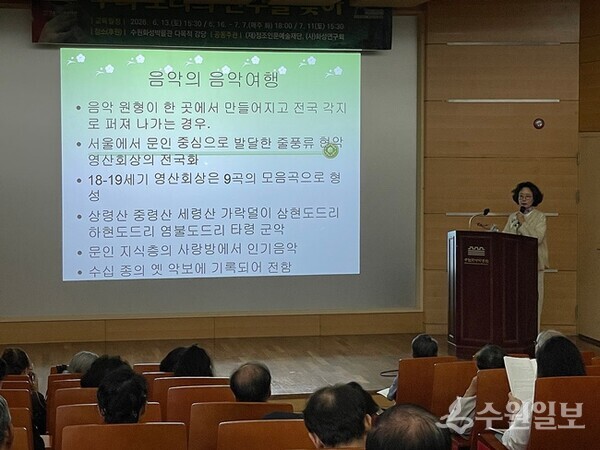
Two sessions have already been held—'A Musical Journey Through the Joseon Era' (13th, Song Ji-won, Director of the Music Humanities Research Institute) and 'Korean Pansori' (16th, Kim Su-mi, Lecturer at Kyungpook National University)—and the audience response has been enthusiastic.
Upcoming sessions include: △3rd lecture 'Gagok, Gasa, and Sijo—Enchanted by the Three Charms of Jeong-ga (正歌)' (23rd at 6 p.m., Moon Hyun from Korea University of Traditional Studies), △4th lecture 'The Greatest Hit Song of the Korean Empire—Japga (雜歌)' (30th at 6 p.m., Song Eun-joo, Ph.D. in Korean Music), △5th lecture 'The Oldest Comfort, Gut—Unraveling Heartstrings Through the Sounds and Repartee of Seoul Gut' (July 7th at 6 p.m., Choi Su-jung, Professor at Dongguk University), △6th lecture 'Curved Lines and Rotations in Gyeonggi Province Sounds, and Arirang' (11th at 3:30 p.m., Kang Hyo-joo, Professor at Ewha Womans University). We hope those interested will attend.
In 1998, Kwon Young-bin, columnist for the JoongAng Ilbo, lamented this in his history column 'The Rise of History Illiteracy.'
'Korean music and Korean history are the same Korean studies, containing the soul and spirit of our nation. While Korean history was neglected, Korean music was treated with disdain. As Korean musicians have gained international recognition through their blood-soaked overseas activities, our own music is being re-imported. Without the study groups of student activists, the popularization of Korean music would have been impossible,' he wrote.
He then advised, 'Though late, I hope to see the activation of systematic Korean music education now. To understand ourselves properly, we must learn our history and listen to the sounds of our nation.'
Reading this article and attending the two sessions of 'In Search of the Essence of Our Sound' that have already been held, I felt profound shame over my ignorance and indifference toward Korean music. I also reflected on myself.
Director Song Ji-won, who led the first lecture, is a Korean music expert who has long hosted 'Song Ji-won's Korean Music Walk' on FM99.1 Korean Music Broadcasting. He introduced Joseon era music under four themes: 'Musical Journey—Departure,' 'Musicians' Musical Journey,' 'Music's Musical Journey,' and 'Musical Journey in Songs.'
The names of master singers such as 'An Min-yeong,' 'Yi Dong-baek,' and 'Song Man-gap,' as well as works like 'Yeongsan회상' and 'Gagok Won-ryu,' which were mentioned in his lecture, I had heard of before, but I did not know them in detail.
And Yi Dong-baek's 'Bird Song,' which I heard for the first time, was deeply moving, even spine-tingling.
Park Sung-hwan, Representative of the Joongje Pansori Promotion Institute, wrote this in the Daejeon Ilbo ten years ago.
'When you listen to Yi Dong-baek's "Bird Song" as restored through gramophone records, there is a powerful taste that pierces the ear from the first measure and compels one to listen to the end. His voice, characterized by a rich and magnificent tone, freely uses high and low, murky and clear tones, beginning plainly and seemingly indifferent, then gradually producing exquisite vocal tones—mimicking the cuckoo when the cuckoo sings and the nightingale when the nightingale sings—ultimately revealing a truly wondrous realm.'
Why am I only now hearing Yi Dong-baek's 'Bird Song,' which has reached this 'wondrous realm'?
In a word, it is due to ignorance and lack of knowledge. Moreover, the wrong prejudice that Korean music is tedious must have played a role.
Director Song said, 'Sichangand Gagok and Sijo alone give a sense of fullness as if one has taken a refined cultural journey.'
He explained that Korean music is a cultural passage connecting people and regions, literature and leisurely pursuits.
Yet here I am—someone who calls himself a poet, someone who has made his living in journalism throughout his life—discovering I was so 'Korean music illiterate.'
I will henceforth attend the remaining four lectures carefully while reflecting on myself. I also hope that others will join me in this reflection.