Kim Woo-young's Gwanggyo Column June 29: The Day Hwaseong Was Effectively Registered as a UNESCO World Heritage Site
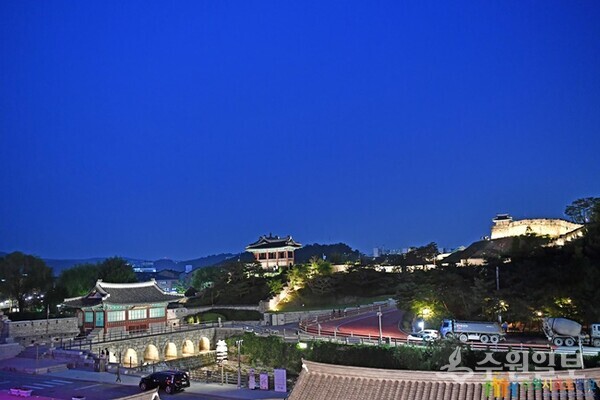
December 6, 1997, marks the day Hwaseong Fortress in Suwon was registered as a UNESCO World Heritage Site at the 21st General Assembly of the UNESCO World Heritage Committee held in Naples, Italy. Upon Hwaseong's registration as a World Heritage Site, Suwon City was swept up in a festive atmosphere.
At that time, I was producing a municipal newspaper called "Evergreen Suwon" in Suwon City, and I gave this news prominent coverage under the headline "Hwaseong Registered as UNESCO World Heritage Site."
I was genuinely delighted. Hwaseong had been recognized not merely as Suwon's heritage but as precious historical legacy of humanity with global significance—a momentous event that gave citizens of Suwon reason to hold their heads high.
Of course, those who went to the site and made the registration a reality—particularly Mayor Shim Jae-deok of Suwon at the time—must have felt joy ten times, a hundred times greater than mine.
A World Heritage Site is humanity's legacy verified and recognized by the entire world, transcending the boundaries of any single nation. UNESCO World Heritage registration enhances the pride of citizens in the designated area. The relevant national or local government must invest greater care in the management and preservation of the heritage site.
As tourists flock to visit World Heritage Sites, local economies benefit as well. Therefore, most nations actively pursue UNESCO World Heritage registration. However, the conditions for registration are by no means easy to meet.
Following King Jeongjo's death, maintenance fell into disrepair. Through Japanese colonial rule and the Korean War, significant portions of Hwaseong Fortress and Hwaseong Palace were damaged or destroyed.
In 1973, the Park Chung-hee administration initiated a project to restore national defense heritage sites. When National Assemblyman Lee Byung-hee included the restoration of Hwaseong Fortress in this project, the fortress began to recover its original appearance.
Subsequently, Mayor Shim Jae-deok, elected as the first elected mayor, clearly understood that tourism would be the future livelihood of Suwon's citizens. While he worked to register Hwaseong as a World Heritage Site to make Suwon a tourist destination on the global stage, it proved far from easy.
Suwon City formally launched its World Heritage registration campaign in 1996, the year marking the 200th anniversary of Hwaseong's construction.
However, the path to registration proved arduous. On June 21, 1997, the Ministry of Foreign Affairs contacted the city, saying, "It appears that Hwaseong's UNESCO World Heritage registration may be postponed at this year's UNESCO board meeting."
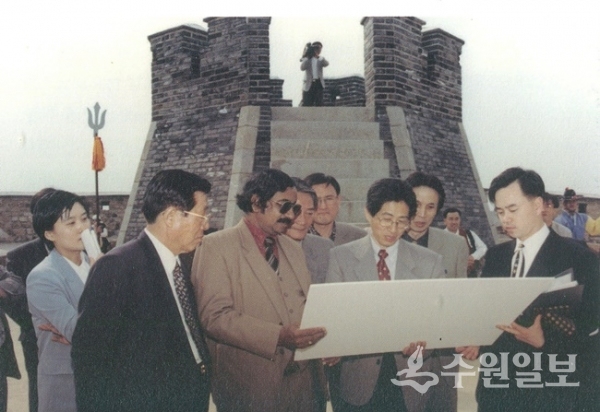
Earlier in early March 1997, Nimal De Silva from Sri Lanka, representing the International Council on Monuments and Sites, had visited Suwon for an on-site inspection of Hwaseong. Because the judgment of the person conducting the inspection could influence registration decisions, Suwon City did its utmost. The inspector expressed a positive opinion, and the city awaited good news of passage through the UNESCO board meeting. However, only Changdeokgung Palace received a recommendation for registration, while Hwaseong's registration was postponed.
Mayor Shim received a significant shock but could not simply wait and see.
On June 23, 1997, Mayor Shim flew to Paris, France, where the UNESCO Executive Board meeting was being held.
In his luggage were a facsimile edition of the "Hwaseong Sungyeok Uigwe" (Record of Hwaseong Fortress Construction) prepared by local historian Lee Jong-hak and a traditional shield kite made in the classical method.
Upon arriving in Paris, Mayor Shim immediately visited the UNESCO Korean delegation. According to a later account by Park Du-ho, the accompanying reporter from Yonhapnews, the UNESCO Korean delegation responded awkwardly to his visit, saying, "There was no need for you to come here. The executive committee members said it wouldn't work..."
Nevertheless, the delegation thoughtfully assigned one secretary to assist Mayor Shim's delegation during their UNESCO business, and even provided an official vehicle and driver.
The UNESCO Executive Board's reason for postponing Hwaseong's World Heritage registration was that "while Hwaseong itself possesses sufficient value as a world cultural heritage, the surrounding landscape is in such poor condition that it cannot be properly preserved." Moreover, there were concerns that given the extensive destruction during the Korean War, could Hwaseong be recognized as an "intact heritage site"?
Under such circumstances, World Heritage registration seemed utterly uncertain.
At this moment, Mayor Shim serendipitously encountered Professor Baek Seung-gil, who was traveling in Paris. Professor Baek was the person who had assisted Nimal De Silva from the International Council on Monuments and Sites during the on-site inspection of Hwaseong in Suwon.
As an internationally recognized museum specialist with extensive connections within UNESCO and well-versed in international protocol, Professor Baek was earnestly entreated by Mayor Shim: "I will arrange a separate European tour for you later; please help me any way you can."
The biography "Mr. Toilet: The Shim Jae-deok Biography" published by the Shim Jae-deok Biography Publication Committee (by Kim Jun-hyuk) contains the following account:
"In the early morning of June 25, Mayor Shim Jae-deok had a strange dream in which he struggled up an endlessly tall staircase, barely reaching near its summit, when someone extended a hand to help him. Shim grasped that hand and finally reached the top. After having this dream, he felt a premonition that something good would happen for Hwaseong's World Heritage registration."
Could the hand that pulled him up have belonged to Professor Baek?
Professor Baek arranged a meeting with the coordinator of ICOMOS (International Council on Monuments and Sites), setting up dates for meetings with seven judicial committee members from the Executive Board. That day was none other than June 25. Mexico held the chairmanship at the time, and Mayor Shim subsequently met with judicial committee members from Australia, Japan, Germany, and elsewhere. UNESCO executives were moved by Mayor Shim's proactive determination.
Mayor Shim promised large-scale maintenance projects to protect Hwaseong. The committee members, sensing Mayor Shim's sincerity, requested several supplementary measures for registration. Mayor Shim promised to purchase land surrounding Hwaseong to create a buffer between the fortress and residential areas, and to attract Hwaseong-related facilities on the purchased land. The UNESCO Executive Committee members viewed Mayor Shim's response positively and placed Hwaseong on the main agenda of the Executive Committee alongside Changdeokgung Palace.
On the evening of June 26, just before the Executive Committee's final decision, a dinner hosted by Mayor Shim Jae-deok was attended by all thirteen Executive Committee members. A UNESCO ambassador, moved by Mayor Shim's passion, had gathered the executive committee members.
At this gathering, Mayor Shim explained the Hwaseong protection program once more. There was also an element of "threat."
"The citizens of Suwon are demanding development from me. Particularly, those living inside Hwaseong's fortress walls are making especially intense demands for development. Because of the Cultural Properties Protection Act, people inside Hwaseong cannot build tall houses or even drive a nail properly. If you do not register Hwaseong as a World Cultural Heritage Site, I will immediately return to Suwon and demolish Hwaseong. Please understand that the disappearance of Hwaseong will not be because of me and our citizens, but because of you."
It was truly a remarkable moment, and even thinking about it now amazes me. I had always known of Mayor Shim's drive and bold nerve. But this was what sort of occasion? It would be questionable to even make a plea, yet here was a threat...
Nevertheless, the Executive Committee members were moved by Mayor Shim's enthusiasm.
Finally, two days after the dinner, on June 29, Hwaseong received a "recommendation for registration" as a World Heritage Site at the UNESCO Executive Board meeting, bolstered by statements of support from representatives of Japan and Australia. This was effectively registration.
None of this would have been possible without Mayor Shim going directly to Paris to meet with and persuade the Executive Committee members. In this process, the facsimile edition of the "Hwaseong Sungyeok Uigwe" published at personal expense by the late Lee Jong-hak, a bibliographer, also proved invaluable.
Finally, on December 6, 1997, at the 21st General Assembly of the UNESCO World Heritage Committee held in Naples, Italy, Hwaseong was officially registered as a World Heritage Site alongside Changdeokgung Palace.
Thanks to the passion and determination of Mayor Shim Jae-deok, Suwon became a city with World Heritage designation and transformed into a tourist city with culture and history, attracting increasing numbers of domestic and international visitors each year.
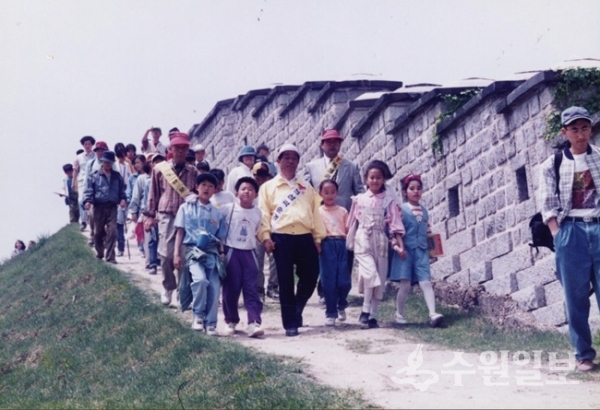
These days, when strolling along Hwaseong, one constantly encounters foreign tourists. On some days, about half of the visitors were foreigners.
The scene Mayor Shim envisioned has become reality. Furthermore, the restoration project of Hwaseong Palace, one of his life's works, has been completed.
Along with King Jeongjo and National Assemblyman Lee Byung-hee, the history of Suwon will not forget Shim Jae-deok, the "eternal Mayor of Suwon."