Kim Woo-young's Gwanggyo Column 'Climbing Namhansanseong and Looking at Ihwamun Gate'
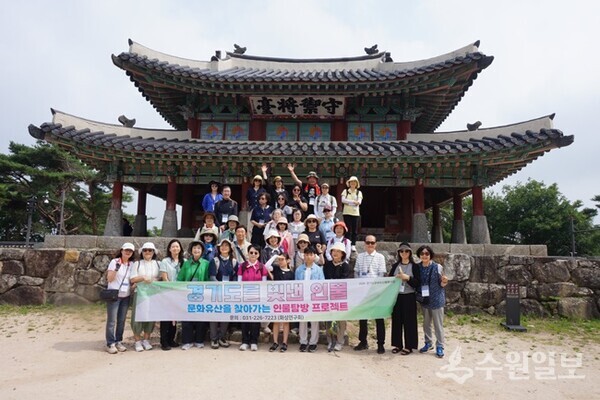
'Climbing Namhansanseong and looking at Ihwamun Gate / See the goshawk soar on the Eastern sky, that skylark / The sunset stretches as gulls cry and weeping willows droop their branches / Orioles fly in pairs toward this mountain with their mating calls of cooee-roo / Mm mm eoheo-ya eoheo-ya diryeo doong-ga / Eoheo doong-ga-doong-ga my beloved'
This is 'Namhansanseong,' recorded in the 'Collection of Korean Folk Songs (New Folk Songs)' of Seong Chang-soon, a master vocalist of the intangible cultural heritage designated as National Intangible Cultural Property No. 5, the pansori 'Simcheong-ga,' who passed away in 2017. The song is more widely known to the general public through singer Kim Se-rena than through Seong Chang-soon's performance.
Some have raised the issue that it should be 'Namwon Sanseong' rather than 'Namhansanseong,' as a southern folk song.
'Namwon Sanseong' refers to Gyoryong Sanseong in Namwon City, and it is said that Ihwamun Gate (梨花門前) refers to the fortress gate of Namwon Sanseong. Moreover, the claim that this song belongs to the southern miscellaneous song 'Doong-ga Taryeong,' named after the refrain 'doong-ga,' also rings true.
I searched to find out where exactly 'Ihwamun Gate' in this lyrics is, but there is no gate by that name in either Namhansanseong or Namwon Sanseong. However, there are Giwhamu Gate (Namwon Sanseong) and Jihwamun Gate (Namhansanseong).
But what does it matter?
Although I have not been to 'Namwon Sanseong (Gyoryong Sanseong),' every time I walk along 'Namhansanseong,' the song 'Climbing Namhansanseong and looking at Ihwamun Gate...' naturally flows from my lips.
In any case, my return to Namhansanseong this time was due to accompanying the Hwaseong Research Society (Director Choi Ho-woon), a non-profit organization, on its 'Exploring Historical Figures and Cultural Heritage that Shine Gyeonggi Province' project.
It is part of the 2026 Gyeonggi Province Cultural Heritage Utilization Project.
The exploration began in Namyangju City on June 20 (astronomers, scientists, and practical scholars who illuminated Joseon), followed by Paju City on June 27 (renowned ministers and upright officials), and Gwangju City on July 4 (construction of Namhansanseong).
Upcoming explorations include Yeoju City on August 29 (footsteps of virtuous rulers and eminent monks), Suwon City on September 5 (meritorious officials of Hwaseong construction), and Yongin City on October 24 (loyal officials of Goryeo and ministers of King Jeongjo).
I was unable to participate in the exploration program held in June. This was due to circumstances such as my daughter's father-in-law passing away.
Like Hwaseong Fortress, Namhansanseong is a truly charming fortress. I have visited it five or six times so far, and each season offers a different feeling. In particular, my favorite time to visit is winter when snow has accumulated, followed by autumn with its magnificent foliage. Of course, spring and summer with their fresh leaves and lush greenery are also wonderful.
Walking slowly in the summer rain, listening to the sound of the rain and gazing at the mist, is also an enchanting experience.
However, after watching the film adaptation of 'Namhansanseong,' based on the novel by Kim Hoon, the place was no longer beautiful and mysterious. Of course, I already knew that Namhansanseong was a battlefield of the Byeongja Rebellion and a historic site where people endured desperate resistance amid cold and hunger until the humiliation at Samjeondo.
However, the thrill I felt while watching the film transformed my somewhat romantic perception of the place.
The exploration began as I recalled several scenes from the film 'Namhansanseong.'
The instructor was Shim Yun-ah, a member of the Hwaseong Research Society. Ms. Shim is a full-time teacher who is popular for getting along well with the members without formality.
"I was so worried I couldn't sleep last night."
However, despite her self-deprecation, she had clearly studied a great deal in preparation for the exploration and delivered the narrative in an engaging manner, earning warm applause.
Today's exploration route included Namhansanseong and the birthplace of Haegong Shin Ik-hee.
Among more than 1,200 fortresses in our country, Namhansanseong is the only one registered as a UNESCO World Heritage Site.
Namhansanseong stands on Namhan Mountain, facing Bukhansan Mountain north of Seoul with the Han River between them. It was a southern fortress that protected the capital city along with Bukhansan Fortress.
According to records in the 'Goryeosa' and the 'Sejong Sillok-Jiriji,' after Onjo founded Baekje and established the capital at Wiryeseong, he moved the capital to Namhansanseong in 6 BCE (the 13th year of King Onjo). However, the 'Namhangi' refutes this, stating that the fortress Onjo established as the capital at that time was Iseongsanseong (二聖山城) beneath Geumdan Mountain, today's Gwangju Goyu-eup.
According to the 'Dongguk Yeoji Seungram,' Gwangju Iljangsan Fortress was newly constructed as Jujangsanseong in 672 CE (the 12th year of King Munmu of Silla). This fortress is Namhansanseong.
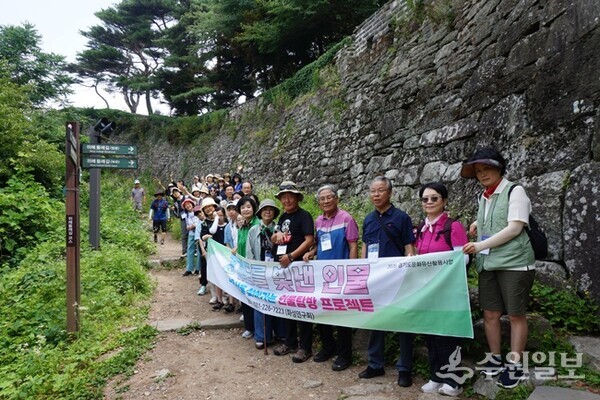
The steps of the exploration participants led through Chimgwaejeong, Sueojangdae and Cheongnyangdang, then to the West Gate, Secret Gate, Yeonju Peak Wongseong, and the North Gate.
These are places I have visited multiple times, but the feeling is different each time I go. Of course, my body's response is different too. That is to say, I am getting older.
There is abundant information about Namhansanseong in many places, so I will not provide additional explanation.
However, there is one figure that Ms. Shim Yun-ah identified as the most tragic victim during this exploration—Yi Hoe (李晦)—that should be addressed.
Yi Hoe was responsible for the southeastern construction work when Namhansanseong was built in 1624 (the 2nd year of King Injo). As is the case today, there were those unable to tolerate others' success, and they made false accusations against him. They alleged that he squandered construction funds privately and neglected the work, failing to complete it within the prescribed period.
Truly incompetent was the king and his inadequate ministers. Had the court conducted a thorough investigation into the matter, the tragedy would not have occurred. Instead, the court sentenced him to execution by beheading.
Upon hearing news of his execution, Yi Hoe's wives threw themselves into a river and took their own lives. They were returning after raising construction funds from the three southern provinces to save their husband.
A later investigation revealed that the terrain in the area under his responsibility was so rugged that construction delays were inevitable, and despite this, the fortress walls were firmly constructed. He was exonerated, and a shrine called Cheongnyangdang was built next to Sueojangdae of Namhansanseong. But what good does that do? The unjust spirits of him and his family could not be consoled.
Nonetheless, I bowed my head for a moment in front of Cheongnyangdang.
After completing the exploration of Namhansanseong, I also visited the birthplace of Haegong Shin Ik-hee, whom I greatly respect.
Haegong was an independence activist who went into exile in Shanghai, China following the March 1st Movement and participated in the establishment of the Provisional Government of the Republic of Korea. After liberation, he served as the chairman of the Constituent Assembly and contributed to the development of Korean democracy. He was also an educator who established Gwangdong Private Academy in his hometown and participated in the founding of Kookmin University as its first president.
He organized the Constitutional Defense Society in opposition to the Susa-o-ip Constitutional Amendment, which the Syngman Rhee regime pursued through scheming for perpetual rule. He also ran as a presidential candidate in 1956 to overturn autocratic rule. The famous slogan of that campaign was 'I cannot live like this; let's make a change.'
He suddenly passed away on a train during his election campaign, shocking the people who yearned for democratization.
Ms. Shim Yun-ah's characterization of Haegong's life was 'independence activist,' 'educator,' and 'politician who led the democratization movement,' and we all nodded in strong agreement.
It was hot. We walked through the fortress sections dripping with sweat in the height of summer. Thanks to that, the beer I drank at Mr. H's house after arriving in Suwon was more refreshing than ever and went down smoothly. I also drank too much.
The next day at lunch, I couldn't properly enjoy the roasted duck stew and grilled duck my daughter and son-in-law had prepared, and I heard complaints from my children.