Kim Chung-young's Suwon Microscope (126) Hidden Scenery of Suwon Hwaseong: Silver Grass Fields Harmonizing with Fortress Walls
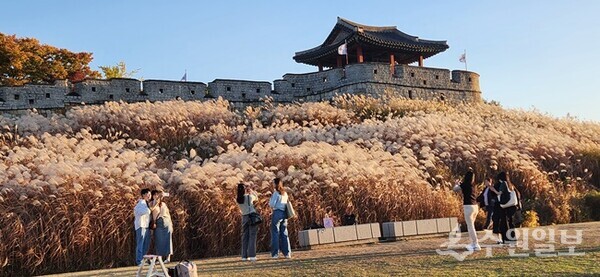
December 6 this year marks the 26th anniversary of Suwon Hwaseong's designation as a UNESCO World Heritage Site.
Since its World Heritage designation, Suwon City has made continuous efforts to restore and maintain fortress facilities and improve the poor environments surrounding the fortress walls, resulting in many changes.
The goal was not simply to showcase the fortress walls. Rather, it was to raise Suwon's identity through Suwon Hwaseong and create a prosperous city through the fortress.
It was not easy. Securing the three elements of tourism—food, sightseeing, and shopping—required investment of time, effort, and funds.
The beginning was the establishment of regular performances of the 24 Martial Arts techniques from "Muyedobotongji," a martial arts manual that King Jeongjo took great interest in completing, starting in 2004. Now, marking 20 years of regular performances, it has become Suwon's representative performance.
The second approach was to create sightseeing attractions by renovating deteriorated areas and planting silver grass fields in parks outside the fortress. Professor Jeong Jae-hun of the Traditional Culture School (former Director of Cultural Heritage Management Division, former Cultural Heritage Review Committee Member) actively recommended this project.
According to historical accounts, trees were not planted in front of the fortress walls. If trees surrounded the fortress, they would obstruct the view during warfare, making it difficult to detect enemies.
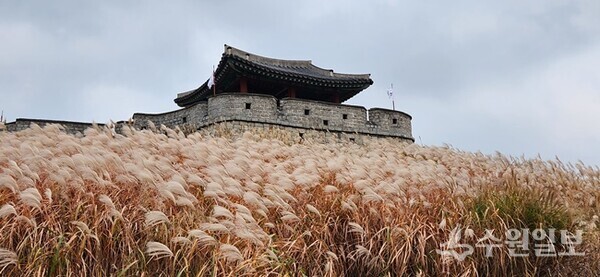
Instead, silver grass was planted around the fortress walls. Silver grass served as material for fire arrows and was used to thatch roofs. Its spring shoots became edible vegetables and served as a famine food. Additionally, it had numerous medicinal properties and was used in herbal medicine. The silver grass flowers planted on Professor Jeong Jae-hun's recommendation became the finest hidden scenery of Suwon Hwaseong.
Food-related attractions were largely addressed as the Shinpung and Jangan-dong areas transformed into café districts during the "Suwon Eco-Traffic 2013" event. Shopping areas are supported by the 230-year-old traditional market around Paldalmun Gate, which continues to attract tourists and citizens.
Currently, magnificent silver grass flowers bloom around Suwon Hwaseong.
Silver grass fields have been established outside the Dongnam Corner Tower behind the Jidong Market and in the Yeonmu-dong area stretching from behind the Dongbuk Gongsimdun to Yongyeon. The silver grass fields along the stretch from Hwaseo Gate to Paldal Mountain also evoke admiration.
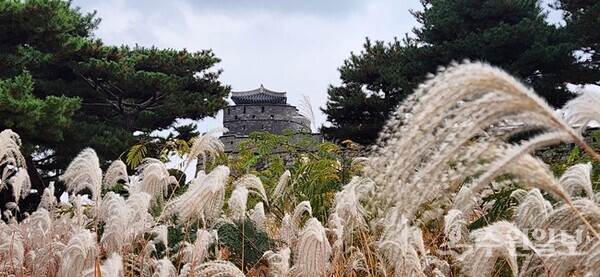
The silver grass field behind Dongbuk Gongsimdun was created in 2006. After parking at the Yeonmu Parking Lot and heading to Changryong Gate intersection, circling back behind Dongbuk Gongsimdun reveals the silver grass field. Gazing at the fortress walls and Dongbuk Gongsimdun from below the silver grass field creates a magnificent spectacle with swaying flowers.
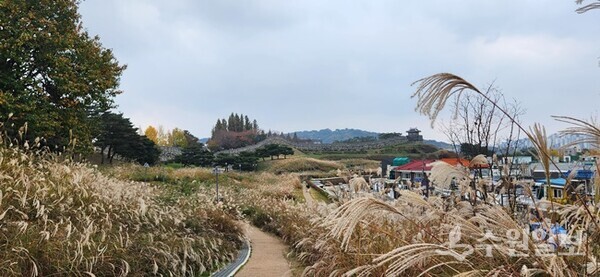
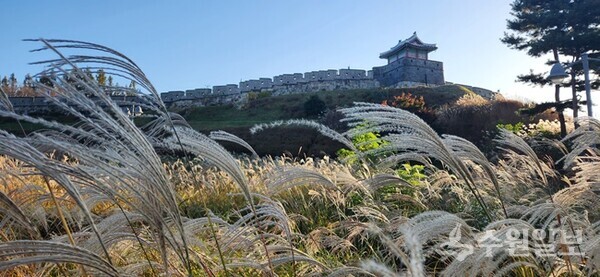
Walking along the fortress wall and passing Dongbuk Amun, one encounters the silver grass field above the Yeonmu Parking Lot, created in 2017. The walking path allows visitors to pass through a silver grass flower tunnel on both sides, becoming fully immersed in the beauty harmonizing with Suwon Hwaseong.
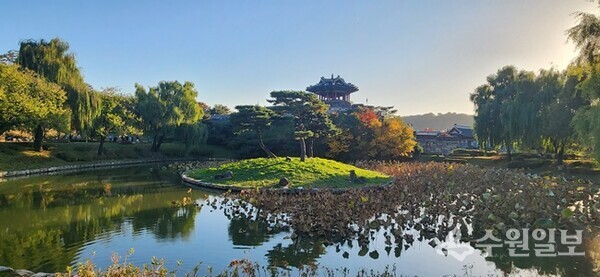
Continuing onward, one encounters silver grass fields around Yongyeon. These days, young couples take photos with the silver grass flowers as backdrops, forming long lines. As the saying goes, the world's most unfailing sights are: first, people-watching; second, water-watching; and third, fire-watching. Here, one can enjoy autumn scenery minus the fire-watching element.
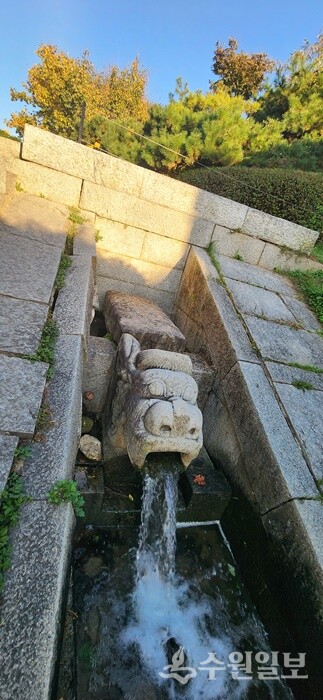
Past Yongyeon lies Hwahong Gate. Behind Hwahong Gate, a stone water spirit spews water from its mouth.
Having the water from Yongyeon spew through the water spirit's mouth symbolizes a promise to ascend the failed water spirit to heaven if it manages the water diligently without negligence.
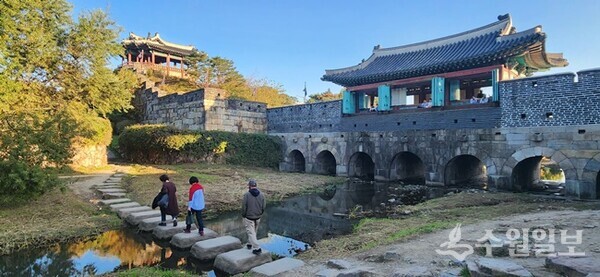
Crossing the stepping stones behind Hwahong Gate, one encounters the seven-arch span of Hwahong Gate. Hwahong Gate means "rainbow gate," and our ancestors were aware that rainbows possess seven colors.
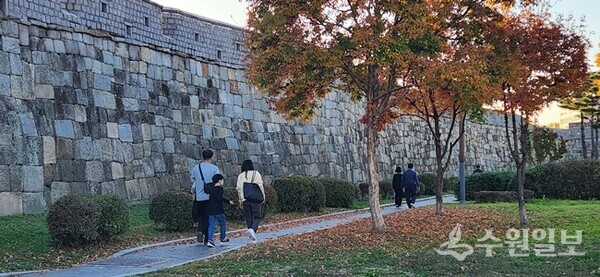
Walking 200 to 300 meters along the fortress wall toward the Younghwa-dong area leads to Jangan Gate.
Jangan Gate is the main gate of Suwon Hwaseong but has endured much suffering. In the 1920s, the Japanese colonial authorities demolished both sides under the pretext of building a roadway, leaving Jangan Gate isolated. During the Korean War in 1950, when North Korean troops hid inside Jangan Gate, UN forces dropped bombs, destroying the gate tower.
It was later restored during the Hwaseong restoration project from 1975 to 1979. In 1995, Mayor Shim Jae-duk of the first civilian-led administration constructed pedestrian overpasses on the severed sections to create a path circumnavigating the fortress. This steel bridge construction project generated considerable debate.
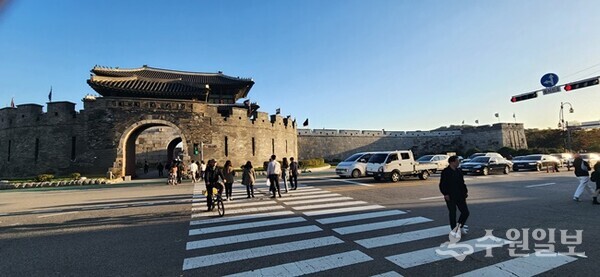
During my tenure as director of the Hwaseong Office, the Cultural Heritage Administration granted time-limited authorization on the condition of removing the steel bridge. At that time, I thought this was an opportunity to connect Jangan Gate. Working with members of the Hwaseong Research Society and experts, we found a solution: connect the western section as it is now and connect the eastern section via a bridge. This allowed citizens to pass through Jangan Gate.
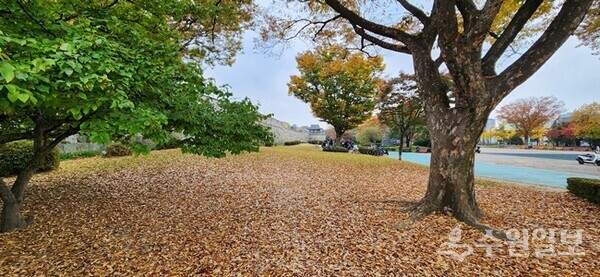
Beyond Jangan Gate lies Jangan Park. This is a park I participated in creating during my initial civil service assignment. In 1979, large trees were considered to obstruct the fortress walls, so thin, small trees were planted. Over 44 years, they have grown into large trees. Jangan Park has become a beloved destination for citizens.
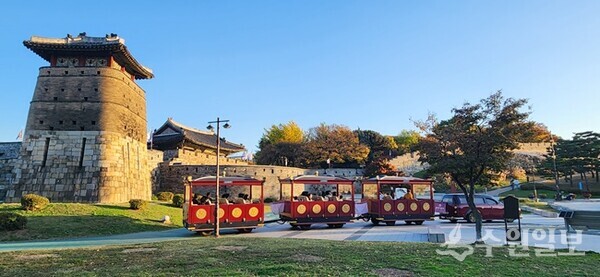
Beyond Jangan Park lie the Northwestern Gongsimdun and Hwaseo Gate. These are among the few original Hwaseong facilities. The Northwestern Gongsimdun, not included in the original design, was constructed under King Jeongjo's direction. King Jeongjo took great pride in the Northwestern Gongsimdun created according to his own design.
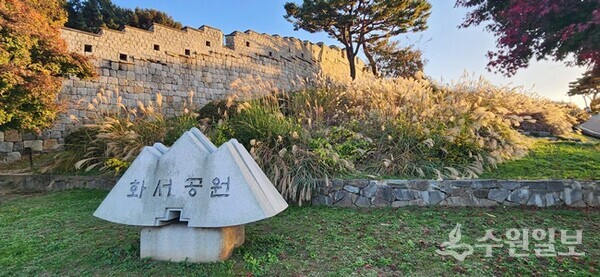
Crossing the road toward Paldal Mountain, a marker stone reading "Hwaseo Park" appears. This marker was erected in 2004 at my suggestion. The parks surrounding Hwaseong were designated as Paldal Park to the west of Jangan Gate and Dong Park to the east. However, the park outside the fortress walls created during the 1975-1979 Hwaseong restoration project was called Jangan Park. Many people use Jangan Park as a meeting location.
It seemed awkward to call the park created after demolishing Seomun Apartment either Paldal Park or Jangan Park. Thus, to indicate the location's character, the nickname Hwaseo Park came into use.
Ascending Hwaseo Park, silver grass fields continue along the fortress wall. This is the original silver grass field of Suwon Hwaseong.
In 2007, a female student lost her mobile phone in the silver grass field and, unable to find it, set a fire thinking the burned grass would make it more visible. What followed is easily imagined.
As autumn deepens, I recommend visiting and walking through the silver grass fields outside the fortress walls before it becomes too late.