Chung-young Kim's Suwon Microscope (139) Suwon Once Had Gwanggyeyo Park
"Gwanggyeyo Park? Does Suwon really have a recreation park like that?"
Clearly, Gwanggyeyo Park existed alongside Woncheon Park.
If you know that Gwanggyeyo Park once existed in Suwon, you are an 'aged Suwon resident.'
In July 1922, a massive flood struck in the Year of the Ox. During this event, Whahong Gate and Namsumun Gate were swept away. Even before this, whenever heavy rain fell, residents along the Suwon Stream had to endure flooding.
Each time, there was mounting public opinion that a levee should be built upstream on the Suwon Stream to prevent flood damage. During the Japanese occupation, Suwon County drew up plans to construct a dam at Gwanggyeo, but progress was slow. The levee construction was undertaken a decade after the 1922 flood—in 1932. Although initially planned for three years, due to budget shortages and frequent heavy rains, two additional years passed, and the levee construction was finally completed in 1937 after five years.
After liberation on August 15, 1945, a phenomenon of rural-to-urban population migration occurred. Subsequently, the June 25 Korean War broke out in 1950, and many refugees flocked to Suwon, causing the population to increase rapidly.
This resulted in a shortage of water for daily use, and in November 1953, Suwon City received approval for a water supply project to convert Gwanggyeo Reservoir into municipal water.
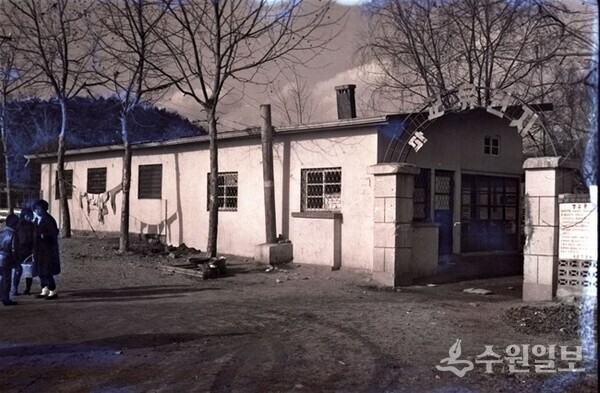
Suwon City installed a water utility office with water intake and purification facilities in Hagwanggyo-dong below the levee and began supplying tap water from 1954.
At this time, a children's pool was created in the stream below the spillway, with many plane trees and wisteria trees planted nearby to provide shade. This became a must-visit destination for Suwon's children every summer.
To resolve the water shortages of citizens rapidly increased after the June 25 War, construction to raise the Gwanggyeo Reservoir levee began in 1958 and was completed in 1962. After the Gyeonggi Provincial Government relocated to Suwon in 1967, Suwon's population increased further. In response, Suwon City completed the third-phase levee heightening project in 1967, and Suwon no longer had to worry about water shortages for the time being.
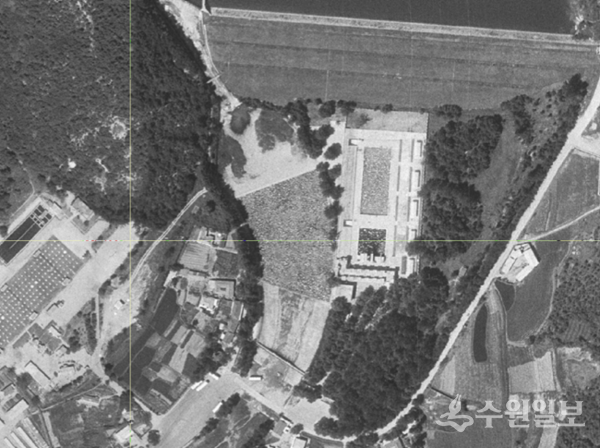
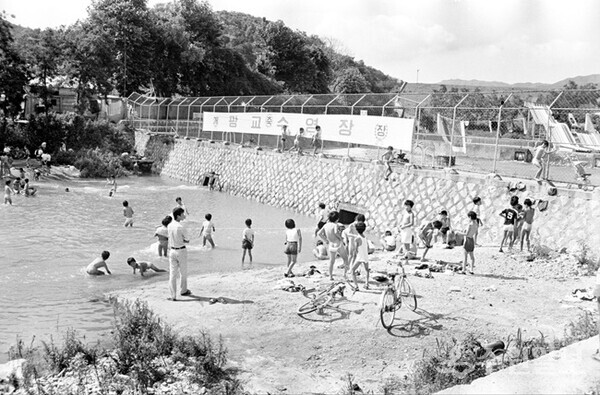
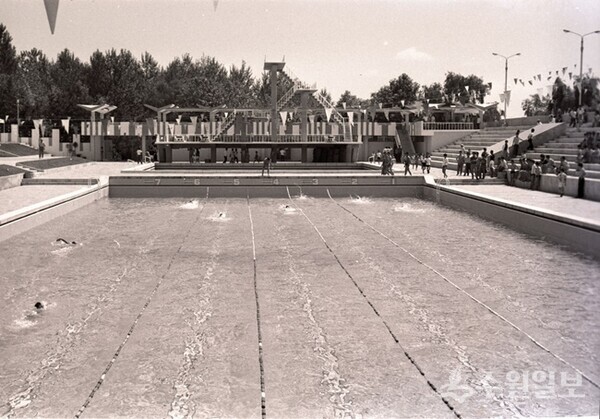
Around this time, opinion arose in Suwon that a swimming pool was needed. With sufficient water available in Gwanggyeo Reservoir, a plan was established to construct a swimming pool below the levee using the reservoir's water. The swimming pool opened on July 1, 1972, and it was Suwon's first regulation 50-meter swimming pool.
In 1972, the author was a second-year student in the Civil Engineering Department at Suwon Technical High School. During surveying class, Teacher Park Seung-nam conducted a program surveying the Gwanggyeo Reservoir levee and experiencing the newly opened swimming pool.
Below the Gwanggyeo levee were plane trees and wisteria shade, a children's pool, and a swimming pool, and Suwon citizens called this place 'Gwanggyeyo Park.'
At that time, Gwanggyeyo Park became a school picnic destination in spring, and a dating spot for young people during strawberry season in May and June. Swimming competitions were held in summer, and exhibition events featuring Jo O-ryeon, an Asian gold medalist at the time, were held. The 1970s was an era lacking proper gathering spaces, so various meetings, dog fighting contests, boxing competitions, and talent shows took place. In winter, it became a sledding spot, and when water wasn't overflowing, it also served as a soccer field.
About a decade after Gwanggyeo Swimming Pool opened, rumors circulated that a private operator would run the pool.
The author tried to confirm when and why Suwon City sold Gwanggyeyo Park through various channels but was unable to find out. Finally, upon inquiring with the Land Management Division of Jangan-gu Office, it was confirmed that ownership was transferred on April 21, 1981.
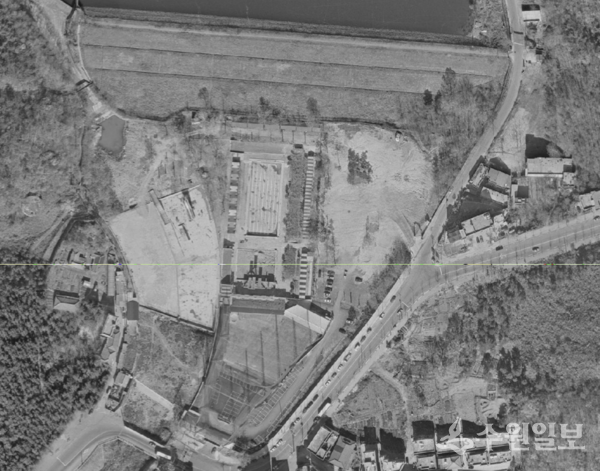
The sale of Gwanggyeyo Park was unfortunate for Suwon citizens. The owner who acquired the Gwanggyeo Swimming Pool began clearing lush plane trees and wisteria in 1992 to develop a profitable golf driving range.
Residents of Yeonmu-dong and hikers on Gwanggyeo Mountain submitted strong complaints to Suwon City as they witnessed the deterioration of Gwanggyeyo Park. According to testimony from resident Choi, who lived near Gwanggyeyo Park, she heard from Suwon City: "Since the land is private property with miscellaneous zoning, Suwon City has no way to prevent it, so we accepted the golf driving range registration."
When Suwon City failed to stop this, all the trees disappeared. Belatedly grasping the situation, the Suwon City Council formed a 'Special Committee for Investigation of Gwanggyeo Golf Driving Range and Comprehensive Sports Facilities' and began its activities.
The 'Special Committee for Investigation of Gwanggyeo Golf Driving Range and Comprehensive Sports Facilities' recommended improving illegal occupation of state and public land and designating the Gwanggyeyo Park area as a park under the Urban Planning Act to restore it to its original use.
Suwon City accepted the City Council's recommendations and pursued park designation, but the Gyeonggi Provincial Urban Planning Committee rejected it, citing infringement of private property rights. Thus, Gwanggyeyo Park was converted into a golf driving range.
The second incident at Gwanggyeyo Park occurred on January 10, 2003. The operator of Gwanggyeyo Park (Gwanggyeo Swimming Pool) filed an application with Suwon City for a building permit to construct an eight-story commercial building with higher profits than the driving range. Suwon City's Building Department granted the permit, stating there were no grounds for rejection under the Building Act.
Consequently, just as in 1993 when residents of Yeonmu-dong and Gwanggyeo Mountain hikers had submitted strong complaints when plane trees and wisteria were damaged for golf driving range construction, they again filed strong complaints. When collective complaints arose, the Government Joint Civil Affairs Office (Ministry of the Interior and Safety) conducted an audit of Suwon City and imposed disciplinary action on the Building Department staff for the impropriety of the building permit.
Suwon City previously designated the old Gwanggyeyo Park area as a park under the Urban Planning Act for park development projects. With this, the owner who had obtained a building permit for commercial construction filed an administrative lawsuit against Suwon City, citing that private property rights had been substantially damaged.
As problems continued to arise related to Gwanggyeyo Park, the Board of Audit and Inspection stepped in. The Board ruled that while there were problems with the building permit, the issue resulted from the Urban Planning Department changing the designation from park to a Type 1 residential zone rather than maintaining park designation. It then stipulated that ongoing administrative litigation was in process and cautioned that disciplinary action could affect the court ruling, so disciplinary measures should be implemented after the lawsuit is finalized.
This was truly an absurd decision. Although Suwon City failed to approve park designation and instead changed it to a Type 1 residential zone (with building height limit of less than four stories from a general residential zone with no height restrictions), the City Planning Department's explanation was not heard. The division chief responsible for this matter was unable to be promoted to director for two and a half years due to this case.
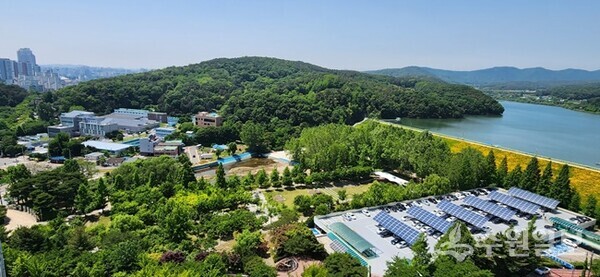
Suwon City repurchased the land that it had sold at a bargain price in 1981, after 24 years had passed in 2005, to develop Gwanggyeo Park. It paid tens of times more than the price received when it was sold.
Gwanggyeo Park, due to inexplicable administrative actions, resulted in the loss of a recreational space for nearby residents and ultimately represented wasteful use of national budget by requiring massive expenditure for repurchase.
Gwanggyeo Park now features an outdoor concert hall, a two-story parking lot, a statue of General Gang Gam-chan relocated for the restoration of Seongshin Shrine on Paldalsan Mountain, and in place of the children's pool, a dancing fountain and grass plaza have been created.
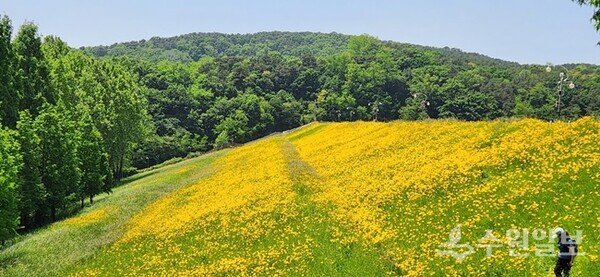
Currently, golden coins flowers in full bloom on the Gwanggyeo Reservoir levee create a spectacular sight. By next week, the golden coins flowers should reach their peak. Before it is too late, I recommend enjoying this spectacle.