2025 Port Special Feature Reinterpreting the Northeast Asian Land Bridge...Why Pyeongtaek and Dangjin Ports Now?
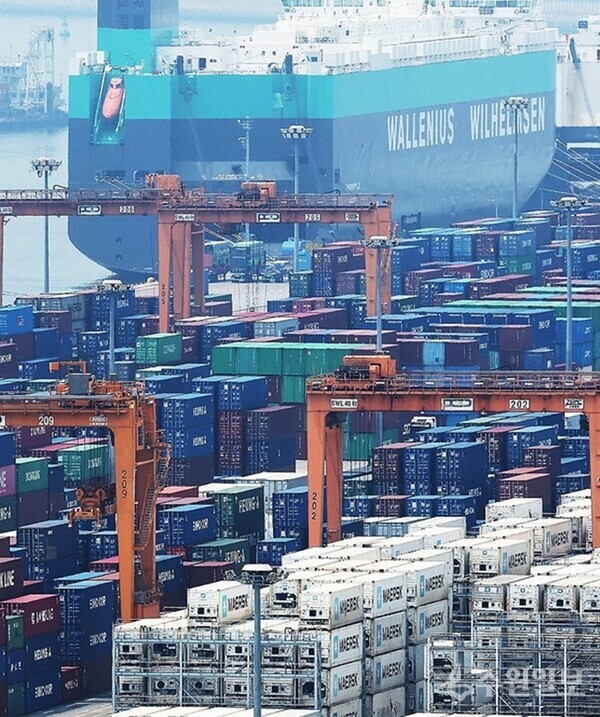
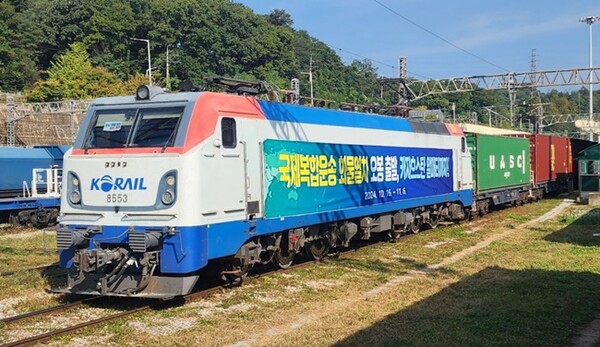
[News S=Reporter Kim Jong-sik] Recently, the Ministry of Land, Infrastructure and Transport and Korean Railroad Corporation have promoted an international intermodal transport pilot project transporting cargo from the Uiwang Logistics Complex to Busan Port to China's Lianyungang Port to Kazakhstan, demonstrating groundbreaking results in reducing transshipment time and significantly decreasing transportation periods. For cargo, transportation time and cost are critical. To reduce these factors, shippers and maritime operators are grappling intensely. Busan Port possesses overwhelming competitiveness as a global port. However, compared to Pyeongtaek and Dangjin Ports, transportation periods are longer, and the large hub port structure could become a risk in sensitive international intermodal transport. Through interest in Pyeongtaek and Dangjin Ports as a new axis of the Northeast Asian Land Bridge and reinterpreting the Northeast Asian Land Bridge...Why Pyeongtaek and Dangjin Ports now?, this article examines issues and improvement directions for the Northeast Asian Land Bridge.(Editor's Note)
Pyeongtaek and Dangjin Ports are emerging as key hubs for South Korea's "Land Bridge Strategy," poised to redraw East Asian logistics geography.
The international intermodal transport pilot project (Uiwang Logistics Complex~railway~Busan Port~China's Lianyungang Port~railway~Kazakhstan) promoted by the Ministry of Land, Infrastructure and Transport and Korean Railroad Corporation from 2024 to 2025 has shaken the existing maritime-focused Northeast Asian trade structure and demonstrated achievements in reducing transshipment time and transportation periods.
Some in the logistics industry, including shippers and shipping lines, believe "a comprehensive system transformation to supplement Busan Port's limitations" is necessary.
As the most realistic and expandable alternative, there is growing interest in Pyeongtaek and Dangjin Ports (with combined functions in containers, automobiles, bulk cargo, and oil), which process cargo 1-2 days faster than Busan Port.
◇The "Cost-Effectiveness" of Northeast Asian Intermodal Transport Altered by Maritime Distance and Port Operation Structure
Busan Port is South Korea's largest transshipment and relay port, but faces structural constraints in that most cargo from the Seoul metropolitan area must travel by truck or rail to the southern coast.
In contrast, 70% of cargo from the Seoul metropolitan area bound for Pyeongtaek and Dangjin Ports is located within a 70-kilometer radius, providing overwhelming port accessibility.
This difference is not merely a distance matter but determines overall efficiency including total transportation lead time, intermodal transport costs, and CO₂ emissions.
From Busan Port to China's Shandong Peninsula, distances are Lianyungang (580 nautical miles), Longcheng (440 nautical miles), and Weihai (440 nautical miles), but from Pyeongtaek and Dangjin Ports, distances are Lianyungang (280 nautical miles), Longcheng (220 nautical miles), and Weihai (220 nautical miles)—approximately 1.5 times closer to the northern and central Shandong Peninsula ports on average.
This results in simultaneous reduction of maritime time and inland transport time, producing the effect of shortening cargo transport time by 1-2 days compared to Busan Port.
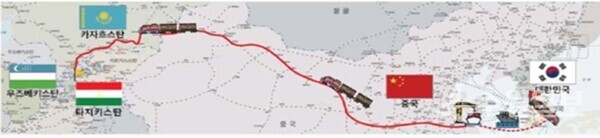
◇Structure Why Pyeongtaek and Dangjin Ports' Intermodal Transport Must Be Faster Than Busan Port
Pyeongtaek and Dangjin Ports' greatest strength is the Seoul metropolitan area-to-port connection lead time.
Using Shandong Province as the benchmark, Busan Port's transportation time, including inland transport from the Seoul metropolitan area and maritime transport, as well as terminal dwell time, requires 3 to 4.5 days total, while Pyeongtaek and Dangjin Ports require 2-3 days.
Busan Port is a globally competitive mega-container hub, but there are indications that terminal congestion, vessel rotation intervals, and transshipment-focused operational structure result in poor "consistency" during intermodal transport.
In contrast, Pyeongtaek and Dangjin Ports, though smaller in scale, are earning the evaluation of "small but fast ports" through optimal port coordination of scheduled liners and RO-RO vessels.
◇Intermodal Transport Cost Model...Pyeongtaek and Dangjin Ports Competitive in Both Cost and Time
Based on routes from the Seoul metropolitan area to Shandong ports, Pyeongtaek and Dangjin Ports' maritime freight rates are 100-150 dollars per TEU, inland truck transport costs 300,000 won, and terminal dwell handling costs 100,000 won, with expected intermodal transport costs approximately 500,000 won cheaper than Busan Port.
Busan Port maintains high maritime freight rates, while Pyeongtaek and Dangjin Ports can maintain relatively lower rates on medium-distance China routes.
Reduced CO₂ emissions and savings in connection costs including road damage and labor expenses further expand the cost difference.
◇Lessons from International Cases...Geographic Advantage Alone Difficult for Success
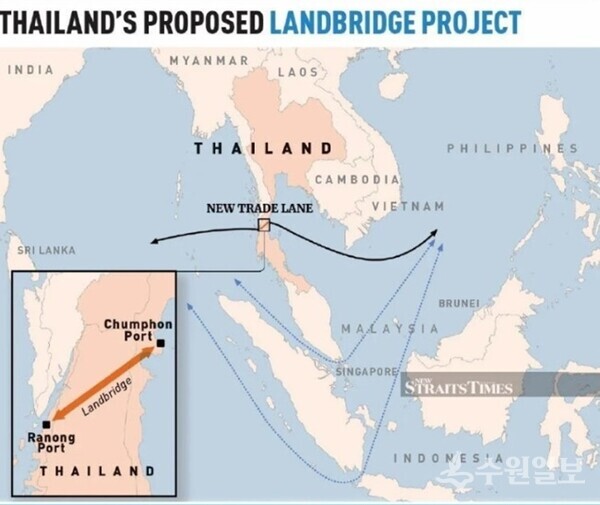
Land bridges are no longer strategies exclusive to North America, the United States, and East Asia.
Through the 'Kra Land Bridge Project,' Thailand is planning to connect the southern Ranong (Andaman Sea) and Chumphon (Thailand Bay) across 90 kilometers via highways, railways, and a large port, linking the two seas overland.
The project targets bidding in 2026 and opening of its first phase in 2030.
Once this project is completed, cargo ships will be able to transport freight instantaneously through Thailand's land bridge rather than the distant, narrow, and congested Malacca Strait.
Through this, Thailand is expected to leapfrog to a geopolitical hub encompassing both the Indian Ocean and Pacific Ocean.
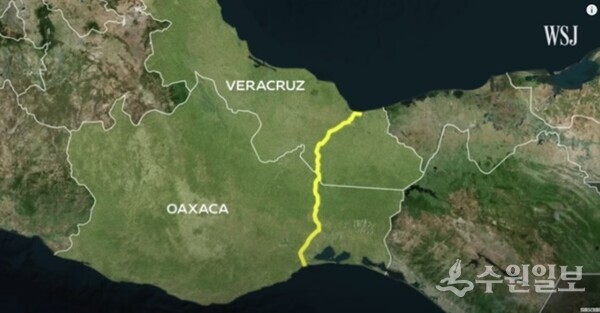
Mexico's Tehuantepec Interoceanic Corridor project is also drawing attention.
With the Panama Canal, historically the center of global logistics flows, becoming unstable compared to the past due to drought and rising costs, the 302-kilometer new intermodal logistics route connecting the Pacific and Atlantic Oceans is garnering attention.
The route runs from Salina Cruz on the Pacific to Coatzacoalcos on the Atlantic, serving as an alternative route to address issues of waiting times through the Panama Canal (up to 2 weeks) and increased freight costs (approximately 8 times higher).
The clear reason nations worldwide are transitioning from "transshipment-focused" to "intermodal transport-focused" is evident.
Carbon reduction, minimization of shipping risks, shortened lead times, and preparation for geopolitical risks are the reasons.
However, some countries face the common challenge that complex infrastructure (ports, railways, roads, customs) and operational coordination must align simultaneously.
These international cases apply equally to the Pyeongtaek and Dangjin Ports model.
Unless ports, railways, shipping, and customs are integrated into one system, the advantages of short-haul maritime segments cannot be fully realized.
◇Clear Practical Limitations...Need to Supplement Shipping Line Networks and Terminal Conditions
Pyeongtaek and Dangjin Ports cannot immediately become an alternative to Busan Port.
The biggest issue is the lack of regular service and absence of economies of scale.
Busan Port is regularly called by global shipping lines, and large container vessels move freely.
In contrast, Pyeongtaek and Dangjin Ports have many mid-sized vessel services, and from shipping lines' perspective, regular route allocation is difficult without securing fixed cargo volumes.
Additionally, supplementation is needed in water depth, berthing capacity, automated equipment, and yard handling capacity.
In particular, because land bridge-type intermodal transport requires inland railways and port schedules to mesh precisely in 1-2 hour intervals, standardization of operational systems including dedicated rail transport, terminal operation protocols, and customs and quarantine procedure simplification is essential.
One shipping line official stated, "To utilize Pyeongtaek and Dangjin Ports, vessel rotation rates and terminal processing capacity must be secured," adding, "If customs procedures do not proceed stably, the time-saving effects could be offset."
◇Preparation for Pyeongtaek and Dangjin Ports Should Begin Now
In phase one, expansion of regular shipping routes to the three major Shandong Province ports (Weihai, Lianyungang, Longcheng), rail transport-Pyeongtaek and Dangjin Ports connection, port automation, and expansion of hinterland facilities are necessary.
Phase two requires implementation of a 'One-Document' system for the Uiwang-Pyeongtaek and Dangjin Ports-Shandong Peninsula-Central Asia section and establishment of an integrated three-party scheduling system among shipping lines, railways, and logistics companies. Introduction of a reduced carbon emissions intermodal transport certification system is also needed.
Phase three requires regularization of intermodal transport routes with northern China, Central Asia, and Europe, expansion of Pyeongtaek and Dangjin Ports' dedicated container piers, construction of a public-private joint logistics data platform, and role division among all ports nationwide (Busan Port: global transshipment, Pyeongtaek and Dangjin Ports: Northeast Asian and Central Asian intermodal transport).
◇'Small but Fast Port' Pyeongtaek and Dangjin Ports Can Be Game Changers
The land bridge strategy utilizing Pyeongtaek and Dangjin Ports is not simply a "substitute for Busan."
It is a new axis for restructuring Korea's entire supply chain.
If Busan is the global hub, Pyeongtaek and Dangjin Ports take on the role of the 'front door' centered on the Seoul metropolitan area.
An era of international intermodal transport linking Shandong Province-Central Asia-Europe.
National competitiveness hinges on who first establishes a 'fast and lightweight structure.'
Port and logistics experts are converging on the view that the starting point is precisely Pyeongtaek and Dangjin Ports.
Korea stands at a juncture where maritime and rail transport networks centered on Northeast Asia are being reorganized.
If Pyeongtaek and Dangjin Ports can stand at the center of this change, Korea will be able to break free from the single-center structure of Busan Port and leap forward as a multiple network country of the Northeast Asian Land Bridge.